Nikon Z8 Review: 9.4/10 - The Pro Mirrorless Without the Pro Price
We may earn a commission from links on this page Learn more
At no additional cost to you. As an Amazon Associate we earn from qualifying purchases; we also participate in the eBay Partner Network (EPN). See our full disclosure.
The Nikon Z8 earns a 9.4 out of 10, offering virtually all of the Z9's capabilities in a body that is easier to carry and $500 cheaper.
photographers and videographers seeking Nikon's advanced capabilities in the Nikon Z8, especially for the Pro Mirrorless Without the Pro Price
your smartphone camera meets your creative needs or the $3496 cost of the Nikon Z8 is outside your budget
Prices last checked July 22, 2026
Overview
The Nikon Z8 is a high-end full-frame mirrorless camera that inherits the core technology of the flagship Z9 in a more compact and affordable body. Announced in May 2023 at $3,496, it features the same 45.7-megapixel stacked CMOS sensor and EXPEED 7 image processor as the Z9, enabling 8K/60p internal raw video recording, 30 frames per second stills capture with full autofocus, and a blazing-fast electronic shutter with no mechanical curtain. It is the most capable camera Nikon has ever made for its size and price.
Design and Build
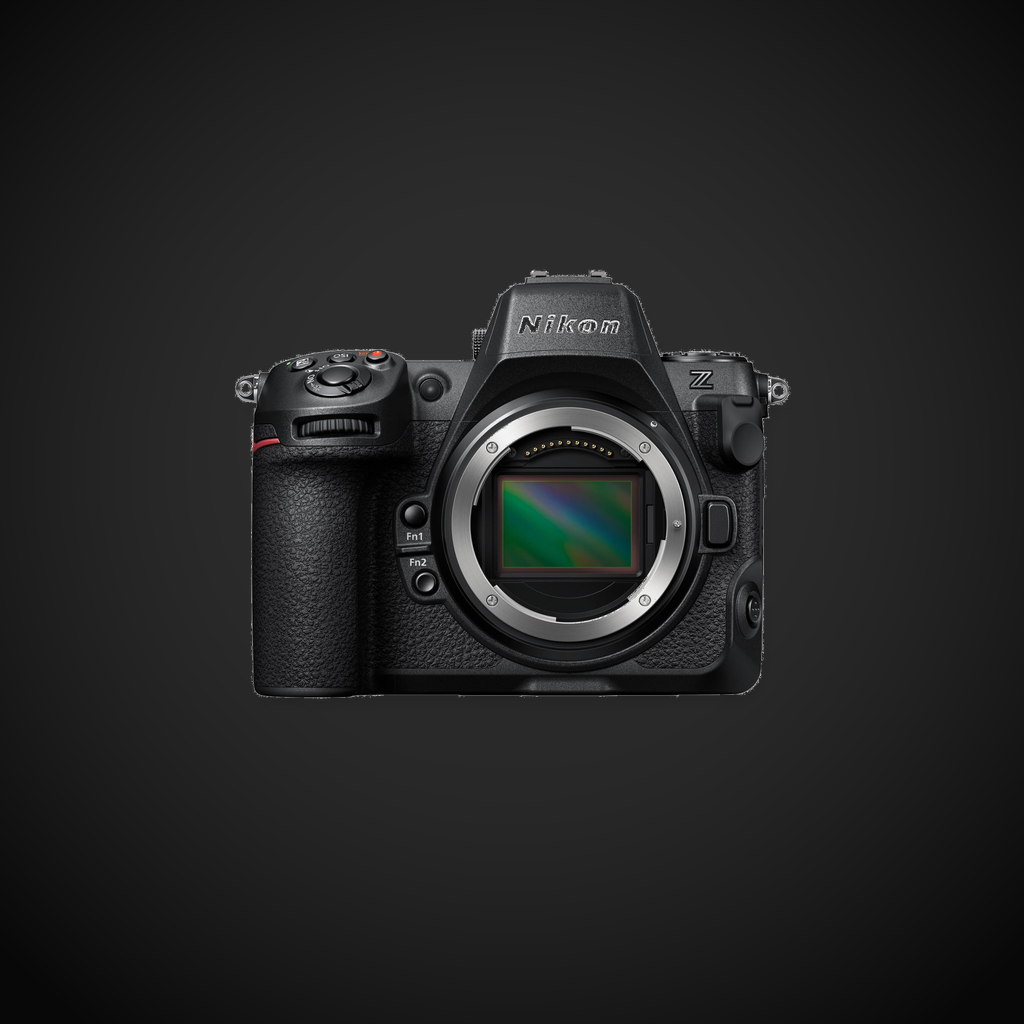
The Z8 adopts a traditional DSLR-style body with a deep grip, a top-panel OLED information display, and a comprehensive button layout that will feel instantly familiar to Nikon shooters. It is significantly smaller and lighter than the Z9 at 910 grams body-only, making it practical for all-day handheld shooting. The magnesium alloy chassis is fully weather-sealed against dust and moisture, and the shutter curtain closes automatically when the camera is powered off to protect the sensor during lens changes.
Sensor and Image Quality
The 45.7-megapixel stacked CMOS sensor delivers exceptional image quality with 14 stops of dynamic range, outstanding color depth, and clean files up to ISO 6400 with usable results even at ISO 25600. The stacked architecture enables the Z8’s incredible readout speed, virtually eliminating rolling shutter distortion in electronic shutter mode. The 5-axis in-body image stabilization provides up to 6 stops of compensation, making handheld shooting at slow shutter speeds practical in low light.
Autofocus System
The Z8 inherits the Z9’s class-leading autofocus system with 493 phase-detection points covering 90 percent of the frame, powered by Nikon’s deep-learning AI that can detect and track people, animals, birds, cars, motorcycles, bicycles, trains, and airplanes. The 3D tracking mode is exceptionally sticky, maintaining focus on moving subjects even through brief occlusions. The Real-Time Eye Detection AF works reliably for both humans and animals in stills and video.
Video Capabilities
The Z8 is one of the most capable hybrid cameras on the market, offering internal 8K/60p recording in 12-bit N-Raw or ProRes RAW HQ, 4K/120p in full frame or Super 35 crop, and 10-bit ProRes 422 HQ internally. The HDMI Type A output delivers clean 10-bit 4:2:2 video to external recorders. Waveform monitoring, focus peaking, zebra patterns, and shutter angle control in a recent firmware update make it a serious cinema camera alternative.
Performance and Handling
The electronic shutter fires silently at 30 fps with full autofocus and autoexposure between frames, and the pre-burst capture mode buffers up to 30 seconds before the shutter is fully pressed. The buffer is enormous, handling over 1,000 JPEG or compressed raw frames before any slowdown. The 3.2-inch tilting touchscreen with 2.1 million dots is bright and responsive, and the 3.69-million-dot electronic viewfinder offers 0.8x magnification with minimal blackout during burst shooting.
Pros
- Same 45.7MP stacked CMOS sensor and EXPEED 7 processor as flagship Z9 in a smaller, lighter body
- Exceptional image quality with 14 stops of dynamic range and clean high ISO performance
- Class-leading autofocus with deep-learning AI subject detection and 3D tracking
- Internal 8K/60p raw video recording in N-Raw and ProRes RAW HQ
- 30 fps silent electronic shutter with full AF/AE and pre-burst capture
- 5-axis in-body stabilization rated for up to 6 stops
- Fully weather-sealed magnesium alloy build with comprehensive controls
Cons
- Shorter battery life than the Z9’s integrated grip battery
- No mechanical shutter limits flash sync to 1/250 second
- No integrated vertical grip option
- 3.69M-dot EVF is good but not class-leading at this price point
Verdict
The Nikon Z8 earns a 9.4 out of 10, offering virtually all of the Z9’s capabilities in a body that is easier to carry and $500 cheaper. The 45.7MP stacked sensor delivers stunning image quality, the autofocus is top-tier, the video specs are exceptional at this price, and the build quality inspires confidence in the field. The battery life is shorter than the Z9’s integrated grip battery, and the lack of a mechanical shutter means no flash sync above 1/250 second, but for photographers and videographers who need uncompromising performance, the Z8 is an incredible value.
Sources
Technical Specifications
How We Scored This Product
Every product on ComfyTechCheck is scored on a 1 to 10 scale across four criteria. Each criterion is weighted differently depending on the product category to reflect what matters most to real buyers.
- Performance & Capabilities 40% Speed, accuracy, quality of output in its category.
- Build & Design Quality 30% Materials, construction quality, durability, form factor.
- Consumer Value 20% Price-to-performance ratio relative to direct competitors.
- User Experience 10% Ease of setup, daily usability, comfort, ergonomics.
Scores are assigned by our editorial team after hands-on testing or extensive research using verified user reports, expert analysis, and technical specifications. For the full weight breakdown by category, visit our How We Rate page.