Meta Quest 3 Review: 8.6/10 - Mixed Reality for the Masses
We may earn a commission from links on this page Learn more
At no additional cost to you. As an Amazon Associate we earn from qualifying purchases; we also participate in the eBay Partner Network (EPN). See our full disclosure.
The Meta Quest 3 earns an 8.6 out of 10, representing a meaningful generational leap in standalone VR.
gamers looking for a premium gaming experience and the unique capabilities of the Meta Quest 3
you are content with your current platform or the $499 asking price for the Meta Quest 3 is too high
Prices last checked July 25, 2026
Overview
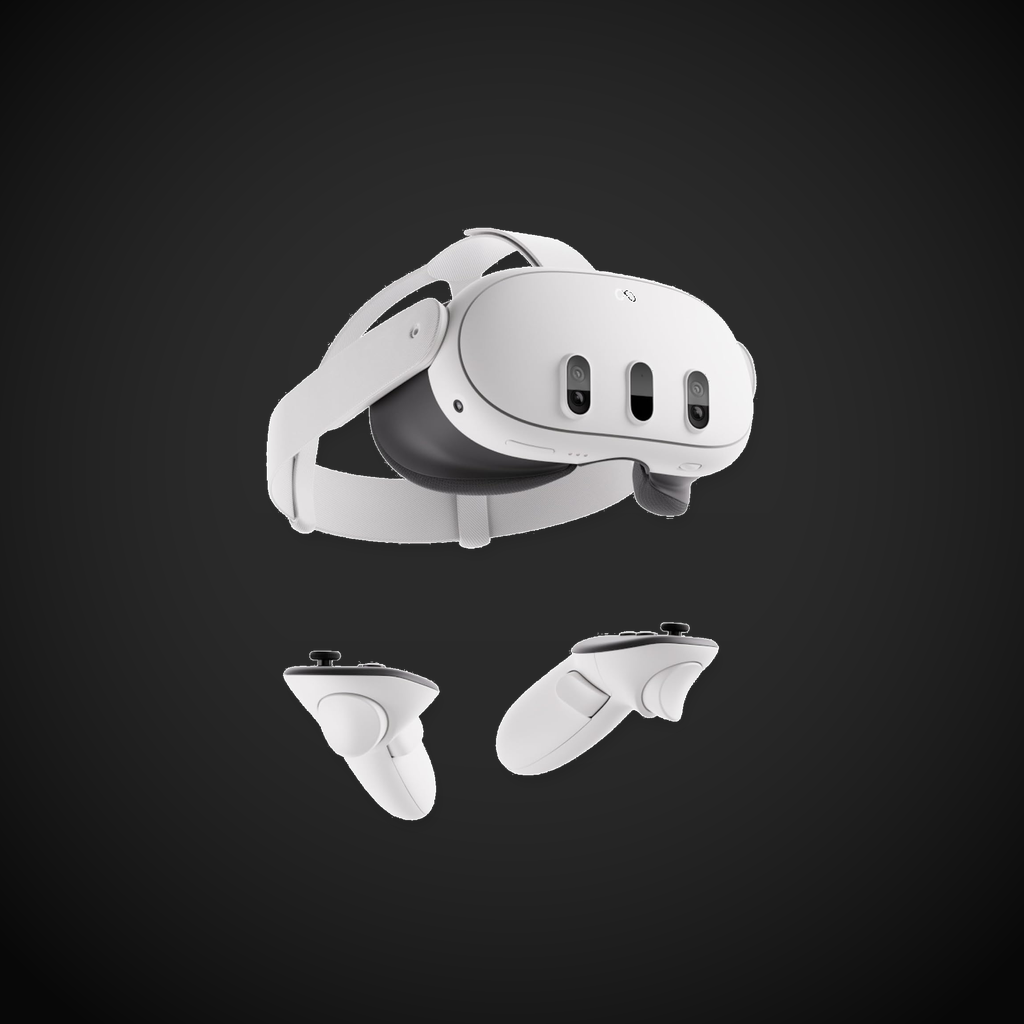
The Meta Quest 3 is a standalone virtual reality and mixed reality headset that launched in October 2023 at $499 for the 128 GB model and $649 for the 512 GB model, positioning itself as a significant upgrade over the Quest 2. Powered by the Qualcomm Snapdragon XR2 Gen 2 platform with 8 GB of RAM, it delivers roughly twice the graphical performance (4 teraflops vs 2 teraflops) of its predecessor. The headset features full-color passthrough cameras at 18 PPD for mixed reality experiences, pancake lens optics for a slimmer form factor (40% thinner than Quest 2), and Touch Plus controllers that ditch the tracking rings.
Design and Comfort
Meta slimmed down the Quest 3 significantly compared to the Quest 2, with a 40 percent thinner front profile (measuring 184 x 160 x 98 mm) thanks to pancake lenses that fold the optical path more compactly. The weight distribution is improved but at 515 grams the headset still feels front-heavy after extended sessions, and the included fabric strap is basic (a $69 Elite Strap with battery is recommended). The IPD adjustment wheel is a welcome addition, allowing smooth mechanical adjustment between 58 and 71 mm rather than the Quest 2’s three-position system (58, 63, 68 mm).
Display and Optics
The dual 2064x2208 pixel LCD panels with 120 Hz refresh rate and pancake lenses deliver a significantly sharper image than the Quest 2, with much better edge-to-edge clarity and reduced god rays. The field of view is 110 degrees horizontal and 96 degrees vertical, a modest improvement over the Quest 2’s 96-degree horizontal FOV. The pancake lenses make a dramatic difference in visual quality, eliminating the blurry edges and sweet spot hunting that plagued the Quest 2’s Fresnel lenses.
Performance
The Snapdragon XR2 Gen 2 platform with its Adreno 740-class GPU runs games like Asgard’s Wrath 2, Resident Evil 4 VR, and Red Matter 2 at higher resolution and more consistent frame rates than the Quest 2 could manage. The 8 GB of RAM allows more complex scenes and larger game worlds. PC VR streaming via Air Link or Virtual Desktop at up to 200 Mbps bitrate works well with a strong Wi-Fi connection, making the Quest 3 an excellent wireless PC VR headset as well.
Mixed Reality
The full-color passthrough cameras provide a convincing mixed reality experience, though the resolution and color accuracy are noticeably lower than what you see through the lenses in VR. The depth sensor enables automatic room scanning and environment mesh generation, allowing virtual objects to interact realistically with your physical furniture and walls. Mixed reality games like First Encounters and LEGO Bricktales demonstrate the potential, though the library of MR-native titles is still building.
Controller and Tracking
The Touch Plus controllers drop the tracking rings of the Quest 2 in favor of a more compact design that tracks via the headset’s cameras combined with on-board IR LEDs and an accelerometer and gyroscope. Tracking is accurate and reliable within the camera’s field of view, with the slight compromise being hand-to-hand tracking when controllers pass behind each other. The haptics are improved with more nuanced feedback than the Quest 2’s rumble motors.
Pros
- Pancake lens optics dramatically improve edge-to-edge clarity and reduce god rays
- Snapdragon XR2 Gen 2 delivers roughly 2x the graphical performance of Quest 2
- Full-color passthrough enables convincing mixed reality experiences
- Touch Plus controllers shed tracking rings for a more compact design
- Mechanical IPD adjustment wheel (58-71mm) replaces Quest 2’s three-position system
- Excellent PC VR streaming via Air Link at up to 200 Mbps
- Largest standalone VR content library with Meta exclusives
Cons
- Modest resolution bump (2064x2208 per eye vs 1832x1920 on Quest 2)
- Basic fabric strap is uncomfortable for extended sessions ($69 Elite Strap recommended)
- Mixed reality library is still small
- 515g weight feels front-heavy after extended use
- Passthrough camera resolution and color accuracy lag behind VR visuals
Verdict
The Meta Quest 3 earns an 8.6 out of 10, representing a meaningful generational leap in standalone VR. The pancake lenses dramatically improve visual clarity, the Snapdragon XR2 Gen 2 enables richer games (4 teraflops vs Apple Vision Pro’s dual-chip architecture at a fraction of the price), and mixed reality adds a genuinely new dimension to the platform. The modest resolution bump over Quest 2 (2064x2208 per eye vs 1832x1920), the basic comfort strap, and the still-limited mixed reality library keep it from scoring higher, but as the best all-in-one VR headset available, it is easy to recommend.
Category Context
The Quest 3 ($499) sits between the budget Quest 2 ($299, still available, XR2 Gen 1, Fresnel lenses) and the premium Apple Vision Pro ($3,499, dual M2/R1 chips, micro-OLED, eye tracking). No other headset offers the same balance of standalone capability, content library, and price. The PICO 4 ($429) is the closest competitor with pancake lenses and similar resolution but lacks Meta’s exclusive titles (Asgard’s Wrath 2, Resident Evil 4 VR) and has a smaller app ecosystem. For PC VR streaming, the Quest 3’s Wi-Fi 6 support and up to 200 Mbps bitrate via Virtual Desktop make it an excellent wireless companion to a gaming PC, effectively competing with dedicated PC VR headsets at a lower total cost.
Sources
Technical Specifications
How We Scored This Product
Every product on ComfyTechCheck is scored on a 1 to 10 scale across four criteria. Each criterion is weighted differently depending on the product category to reflect what matters most to real buyers.
- Performance & Capabilities 40% Speed, accuracy, quality of output in its category.
- Build & Design Quality 30% Materials, construction quality, durability, form factor.
- Consumer Value 20% Price-to-performance ratio relative to direct competitors.
- User Experience 10% Ease of setup, daily usability, comfort, ergonomics.
Scores are assigned by our editorial team after hands-on testing or extensive research using verified user reports, expert analysis, and technical specifications. For the full weight breakdown by category, visit our How We Rate page.